Table of Contents
ToggleGum health is the foundation that everything else in dentistry sits on. You can have the most beautiful veneers or the strongest crowns in Miami, and if the gums and bone underneath are not healthy, none of it lasts. That is the reason Sharp Dentistry brought Dr. Liliana Aranguren, our periodontist, into the practice – so that patients seeking specialist periodontal care in Miami can receive it under the same roof as their cosmetic and restorative work, without being referred out to a second office.
This guide walks through what a periodontist does, the conditions they treat, how periodontal treatment actually works, and why having the specialist inside a full-service practice matters more than most patients realize.
What Does a Periodontist Do?
A periodontist is a dental specialist with three additional years of hospital-based training beyond dental school, focused on the tissues that support your teeth – the gums, the periodontal ligament, and the bone of the jaw. Periodontics is one of the specialties formally recognized by the American Dental Association.
Periodontists treat:
- All stages of gum disease, from early gingivitis to advanced periodontitis
- Infections around dental implants (peri-implantitis)
- Gum recession and exposed tooth roots
- Aesthetic gum concerns like gummy smile
- Bone loss that requires grafting to rebuild
At Sharp Dentistry, this care is provided by Dr. Liliana Aranguren, whose training spans both therapeutic and cosmetic periodontal procedures.
The Periodontal Conditions Miami Patients See Most Often
Gingivitis
Early-stage gum inflammation. Bleeding when you brush, redness at the gum line, mild swelling. This is the only stage of periodontal disease that is fully reversible with professional cleaning and consistent home care.
Chronic Periodontitis
The most common form of advanced gum disease. Slow, progressive loss of the bone and connective tissue that hold teeth in place. It cannot be reversed, but with proper treatment it can be stopped and managed for the long term.
Aggressive Periodontitis
A faster-progressing form that often affects younger, otherwise healthy patients. Because it can cause significant bone loss quickly, prompt specialist attention matters.
Peri-Implantitis
Infection and bone loss around a dental implants. This has become more common as implants are placed more widely. Caught early, it is highly treatable. Left alone, it can end an implant years before its expected lifespan.
Gum Recession
When gum tissue pulls back and exposes the roots of the teeth. Causes sensitivity, longer-looking teeth, and long-term risk of root damage. Grafting can restore both function and appearance when treated early.
How Periodontal Treatment Works: A Three-Phase Approach
Periodontal treatment at Sharp Dentistry follows a structured, three-phase process, because gum disease is rarely a single-visit problem.
Phase One: Infection Control
The first phase brings the active infection under control. That usually involves scaling and root planing – a deep cleaning below the gum line to remove plaque and tartar and smooth the tooth roots so bacterial toxins do not have a place to hide. Antibiotic therapy is added when the infection warrants it, and home-care coaching (brushing technique, flossing, smoking cessation) does the other half of the work.
For many patients with early-to-moderate disease, phase one is the entire treatment.
Phase Two: Surgical Intervention When Needed
When non-surgical treatment cannot reach deep enough or bone loss is advanced, periodontal surgery may be required. Options include:
- Osseous surgery – reshaping infected bone and tissue to allow healing
- Bone grafting to rebuild jaw bone that has already been lost
- Guided tissue regeneration to encourage regrowth of periodontal structures
- Extraction and immediate implant placement when a tooth cannot be saved
Phase Three: Long-Term Maintenance
Periodontal disease is not cured – it is controlled. Phase three is ongoing: three-month maintenance cleanings, home-care review, and monitoring for early signs of recurrence. Skipping maintenance is the number-one reason periodontal treatment fails long-term.
Aesthetic Periodontal Care: More Than Just Gum Disease
Not every periodontal patient comes in with an infection. Many come in with an aesthetic concern – most commonly, a gummy smile.
Gummy Smile Treatment
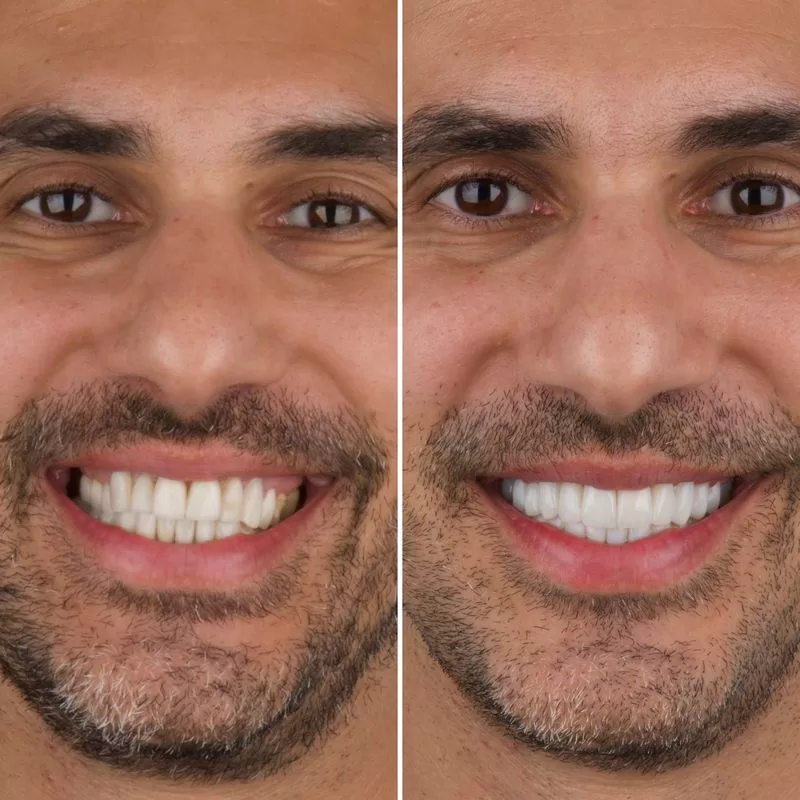
A gummy smile is one where too much gum tissue shows when you smile. Causes vary: excess gum tissue, a hyperactive upper lip, short tooth crowns, altered passive eruption, or a combination. Sharp Dentistry offers three main approaches:
- Laser gum contouring – precise reshaping with fast healing, often in one 15 to 30-minute visit
- Crown lengthening – reshaping both gum tissue and underlying bone for more significant corrections
- Gingivectomy – surgical removal of excess gum tissue to create a balanced smile line
Gum Contouring and Root Coverage
For patients with uneven gum lines around individual teeth, contouring fine-tunes the smile line so restorations look balanced. Root coverage grafting restores lost gum tissue where recession has exposed the roots, addressing both sensitivity and the visual imbalance recession creates.
The Advantage of Specialist Periodontal Care Under One Roof
Most Miami dental practices refer periodontal cases out to a separate office. That means a second consultation, a second clinical team learning your history, and back-and-forth coordination between offices for anything complex.
At Sharp Dentistry, that coordination happens in-house. When periodontal care is a prelude to veneers, crowns, or implants, Dr. Aranguren works directly with Dr. Bruno Sharp, our prosthodontist, so the foundation and the restoration are planned together from day one. If you need a gum lift before cosmetic work, both parts of the plan sit with the same team, in the same building.
The in-house dental lab supports this too. For implant-related periodontal work, the crown or bridge that eventually sits on the implant is crafted on-site, so the surgical and restorative phases stay tightly coordinated.
Complex veneer and crown cases that follow periodontal treatment are built here as well, which is why veneer work at Sharp Dentistry is designed to last a lifetime – the foundation is treated first, then the restoration is crafted to match a stable, healthy gum line.
That kind of integrated planning is unusual in Miami. It is why Sharp Dentistry has become a destination for complex cases where periodontics, prosthodontics, and laboratory work all need to move in the same direction.
Book Your Periodontal Consultation
If you have been putting off gum treatment or living with a gummy smile you would rather correct, the next step is a straightforward conversation. Sharp Dentistry & Associates in Coconut Grove offers specialist periodontal care from Dr. Liliana Aranguren, coordinated with the practice’s cosmetic and restorative team so your entire treatment plan moves together.
Call Sharp Dentistry at (305) 857-0990 to schedule your periodontal consultation.
Frequently Asked Questions
Bleeding gums, persistent bad breath, receding gum lines, loose teeth, or changes in how your teeth fit together are common signals. A general dentist can identify early gum disease, but advanced cases and cosmetic gum concerns are best handled by a periodontist.
Most periodontal treatments are done with local anesthesia and are far more comfortable than patients expect. Laser procedures and modern surgical techniques have significantly reduced both intra-treatment and post-treatment discomfort.
Gingivitis, the earliest stage, is fully reversible with proper professional cleaning and consistent home care. Periodontitis, once it has progressed to bone loss, can be controlled and stopped but not fully reversed. This is why early treatment matters.
A gummy smile shows more gum tissue than average when smiling. It can be treated with laser gum contouring, crown lengthening, or a gingivectomy – often in a single visit with results that are visible immediately.
Most periodontal patients are placed on a three-month recall schedule after active treatment. That interval keeps the disease from returning silently between routine visits.
Yes. Consultations and treatment can be conducted in Spanish, which matters for many patients across Coconut Grove and greater Miami.